




EUDR in Brazil: how medium and large companies must prepare to continue selling to the European Union
For many Brazilian companies, selling to the European Union is set to require more than just a competitive price, quality and delivery capacity. Product origin traceability, the geolocation of production areas and the ability to demonstrate supply chain legality will carry an increasingly heavy weight in accessing the European market.
This change is the result of EU Deforestation Regulation – EUDR (Regulation (EU) 2023/1115), whose obligations will apply to medium and large companies as from 30 December 2026.
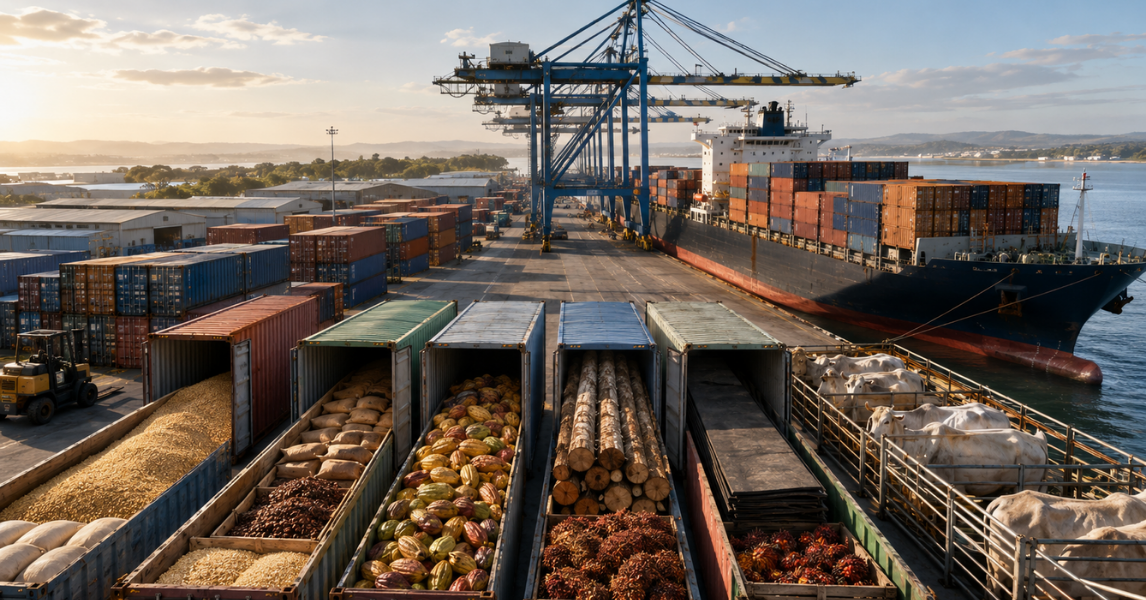
The regulation covers products associated with seven raw materials: soy, palm oil, timber, coffee, cocoa, cattle and rubber, as well as several of its derivatives.
For Brazil, one of the main producer and exporter countries of several of these raw materials, the issue deserves attention. The impact is not limited to companies that export directly to Europe. It can reach producers, industries, traders and suppliers who participate in chains whose final destination is the European market.
The need for more informed decisions that are aligned with operational realities is leading more and more managers to resort to structured analysis processes before defining investments, goals, and priorities for the new year.
Who should be alert?
Companies linked to agribusiness, coffee, livestock, leather, timber, paper, furniture, rubber and the food industry are among those that must evaluate their exposure to the EUDR with greater attention.
The initial analysis must be carried out product by product and supply chain by supply chain.
Even when the Brazilian company is not responsible for the formal submission of the declaration in the European Union, its clients may depend on it to obtain an important part of the information required for compliance with the regulation.
A European importer or client could, for example, request data on the origin of the raw material, suppliers involved, location of the production areas and documentation demonstrating the legality of the operation.
For this reason, for a Brazilian company, knowing whether it is directly covered by the regulation is only part of the question. It is equally important to realise whether it currently has the information that its European clients may begin to demand.
The biggest challenge lies in the supply chain
The EUDR establishes 31 December 2026 as a reference date to determine whether the products covered are associated with deforestation or forest degradation.
In practice, this forces companies to better understand the origin of the products they sell.
In simple chains, the process can be relatively straightforward. In large corporate groups, with hundreds or thousands of suppliers, different countries of origin and multiple levels of intermediation, the reality is rather more complex.
The company may have to gather information that is currently distributed across various departments, suppliers and systems. Commercial data, customs documentation, geolocation, the origin of raw materials and evidence of legality will need to be linked together.
As a result, the EUDR will hardly be an isolated project for the sustainability or compliance department. Procurement will have to review the information requested from suppliers. Foreign Trade will have to ensure the correct categorisation of products and documentation. Legal and Compliance will have to structure due diligence procedures. The Technology and Data areas may need to adapt systems to manage high volumes of information and traceability.
For management, the issue is primarily operational and commercial: will the company be in a position to continue supplying its European customers without interruption?
Insufficient preparation can translate into problems that go far beyond red tape, including shipment blocks, sanctions, seizure of products and difficulties in accessing the European market.
TRACES NT is only part of the process
When discussing the EUDR, the focus of the discussion is frequently on TRACES NT and in Due Diligence Statements (DDS).
The platform is important, but it doesn't solve the main challenge for companies.
The system allows you to register and manage declarations associated with the covered operations. However, it does not automatically collect information from suppliers, does not confirm the accuracy of the data entered, and does not, in itself, carry out all the necessary risk assessment.
The responsibility for obtaining, organising and validating the information remains with the company.
It is precisely in this phase prior to submission that the greatest difficulties can arise: suppliers that do not have the necessary documentation, incomplete geolocations, information scattered across various systems or a lack of clear procedures for collecting and validating the data.
For a company with a complex supply chain, preparation for the EUDR begins long before logging onto the platform.
If a European customer asks for the data tomorrow, how long does the response take?
This is a simple way of understanding an organisation's level of preparedness.
If one of the main European clients requests traceability and evidence of origin for a certain product tomorrow, can the company respond with organised and validated information?
Or will you have to identify internally who holds the data, contact suppliers and reconstruct part of the chain?
This difference is relevant because the quality of the response will depend on the work done over the coming months.
The date of 30 December 2026 it should not, therefore, be seen as the time to start preparation. For larger companies, supplier mapping, the collection of origin data, the validation of geolocations, document review and the adaptation of processes can take several months.
When there are different business units, countries, systems and hundreds of suppliers, the work becomes even more demanding.
The starting point must be the identification of the company's actual exposure: which products are covered, which trade flows are relevant, what information already exists and where the main gaps are.
Preparing beforehand can make a difference in business relationships
The EUDR brings new obligations, but it could also change the way European buyers evaluate their suppliers.
For a European client subject to the regulation, working with a supplier capable of rapidly providing information on origin, traceability and legality represents less operational risk.
This factor may gain importance in supplier selection and retention processes.
A Brazilian company that can demonstrate a well-organised supply chain, with consistent data and clear processes, will naturally be better positioned than one that only begins to gather this information when requested by the customer.
Compliance thus also acquires a commercial dimension.
How can OFG support Brazilian businesses?
Preparation for the EUDR spans several areas: international trade, supply chain, customs procedures, compliance, auditing, technology, data, and supplier management.
It is with this integrated vision that OFG – Oporto Forte Group develops the service of EUDR and TRACES NT Consultancy.
Work begins with a Diagnosis & Gap Analysis, through which the relevant products, raw materials, suppliers and flows are identified, as well as the main gaps regarding the regulation's requirements.
Below is the value stream mapping, including the collection and organisation of source data, geolocation, supplier assessment and evidence of legality.
During the implementation phase, we support the structuring of processes due diligence, TRACES NT and DDS and, in larger-scale operations, integration with internal systems, ERPs or APIs.
The approach may also include auditing and verification, team training and ongoing compliance monitoring.
The OFG brings together expertise in international trade, compliance, customs processes, AEO, auditing, training and internationalisation, with practical knowledge of the relationships between producer markets and the European Union.
It is this combination that makes it possible to approach the EUDR not only from a regulatory perspective, but also taking into account the actual functioning of the supply chain and international operations.
The first step is to realise where the gaps are
For a medium or large Brazilian company, it is not necessary to start with a technological transformation or a complex project. It is more useful to start by understanding the current situation.
Which of the company's products are covered? Which customers and markets are exposed? How far can the origin of the raw materials be traced today? What information is missing? Which suppliers will need to be involved?
An early diagnosis makes it possible to set priorities and prepare the business progressively, rather than trying to resolve all the requirements when deadlines are approaching.
For Brazilian businesses that have the European Union as a current or strategic market, this work could be decisive in reducing risks and preserving commercial relations.
O OFG – Oporto Forte Group supports companies at all stages of this process, from diagnosis and supply chain mapping to the implementation of due diligence, TRACES NT, auditing and continuous monitoring.