Happiness Programme · Mental Health & Skills Development
Happiness Programme / Mental Health & Skills Development
An integrated approach to strengthening well-being, developing skills and driving sustainable results aligned with NR-1 and ESG.
Initial diagnosis free of charge and with no obligation.
Oporto Forte Group
Since 1993, the OFG, Oporto Forte Group, has been a business hub connecting people, companies, businesses and opportunities globally.
With a direct presence on 4 continents and operations in over 10 countries, we support governments, institutions and businesses in their expansion and transformation.














ESG is no longer a requirement, it has become a competitive advantage, and people are its core
The corporate world is experiencing a profound transformation: investors, clients and regulators demand increasingly concrete evidence of how organisations treat their people. Social ESG has gone from being an annual report to becoming a measurable daily practice.
of investors increased their use of ESG information in decisions
EY Institutional Investor Survey 2024
two out of three investors prioritise human capital in ESG
Georgeson Global Institutional Investor Survey 2024
of average return on mental health and wellbeing programmes
Deloitte, Mental Health and Employers
An ESG report without a transformation programme does not generate real progress.
World Economic Forum
The scientific numbers that justify the investment in corporate happiness
in teams with high engagement
Gallup
associated with happier and more engaged employees
Harvard Business Review
among colleagues who received feedback on their strengths
Gallup
in highly engaged teams
Gallup
These are not just HR indicators. They are precisely the KPIs that ESG investors look for in sustainability reports. Absenteeism, staff turnover and productivity are direct metrics of the criterion S, Social, whilst ROI and responsible growth meet the criterion G, Governance.
A questionnaire is not compliance.
When the obligation arrived, the market became flooded with questionnaires. But the standard does not ask for a number; it asks for a management cycle. Anyone who treats assessment as a mere formality generates data without application and weakens their own PGR.
Psychosocial hazards in the GRO
MTE Ordinance 1,419/2024. Work overload, harassment and low control are now included in the risk inventory, alongside NR-17.
In force from 26.05.2026
Those who do not manage psychosocial risk are exposed to enforcement action and liability.
Continuous cycle, not one-off
Identify, evaluate, classify, control and monitor, in a PDCA cycle of continuous improvement.
Risk of penalty notice and weak PGR
See what the diagnosis would look like in your operation.
Pyramid of Value
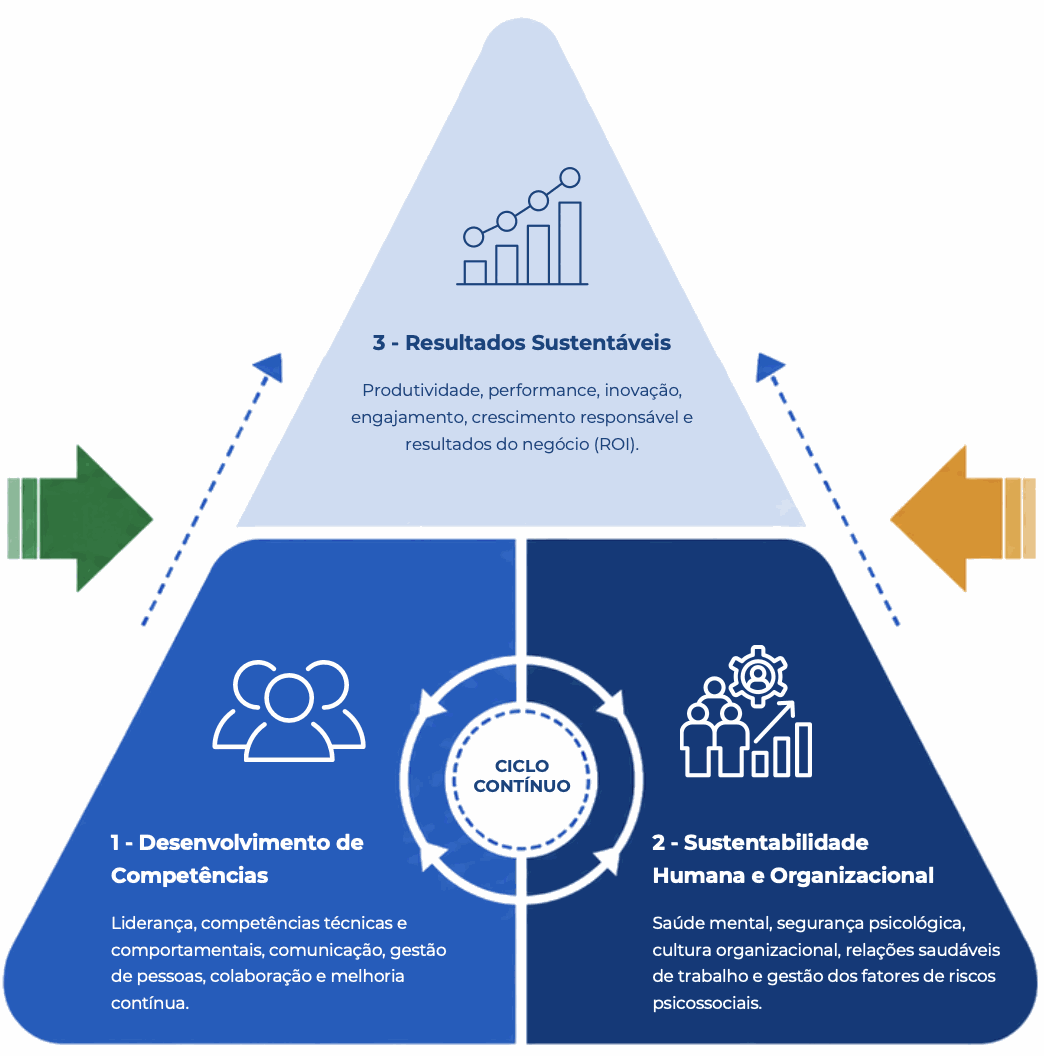
Our approach can be understood as a progressive journey
Understanding and strengthening the human factors that influence well-being, psychological safety, the prevention of psychosocial risks and the quality of workplace relationships. This stage lays the foundations for a healthier, more collaborative organisational culture that is prepared for the sustainable development of both people and results.
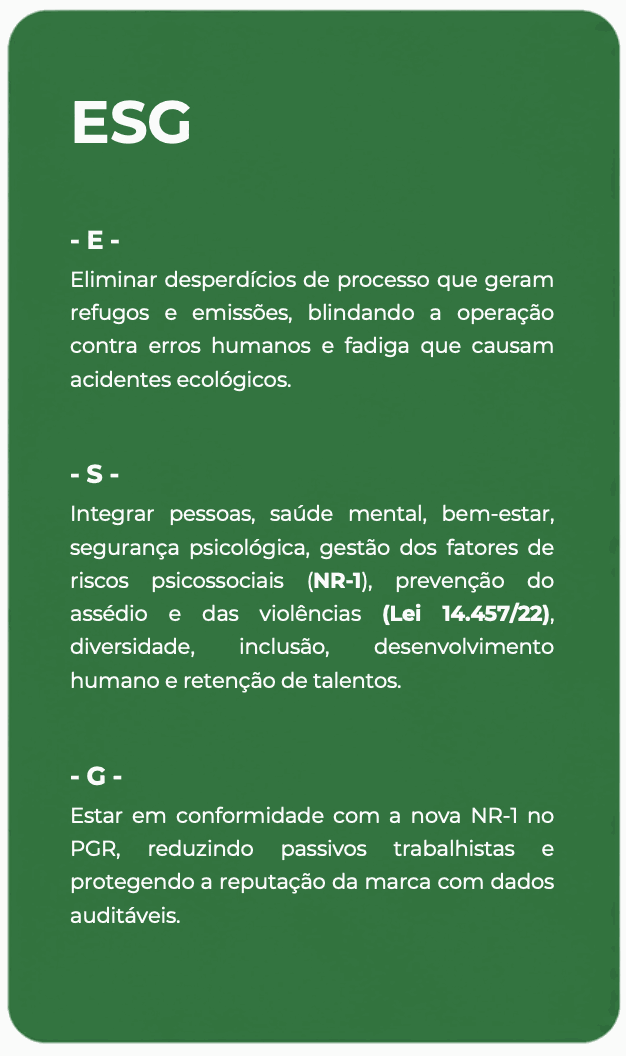
People, mental health, well-being, psychological safety, management of psychosocial risk factors (NR-1), harassment and violence prevention (Law 14.457/22), diversity, inclusion, human development and talent retention.
Consolidate a culture of sustainable high performance, where people development, organisational health and the application of competencies contribute to increased productivity, performance improvement and responsible business growth.
The complete cycle, all in one place.
Diagnosis
Anonymous evaluation by area
Classification
Indices and criticality matrix
Action and training
Risk-directed pathways
Evidence
Documented record
Reassessment
Measure the improvement
Where others stop, the platform acts.
The risk identified by area is linked to a training trail. The corrective action is generated on the same platform, with evidence.
Anonymity that protects both sides.
The standard evaluates working conditions, not people. That is why anonymity is not a promise, it is built into the architecture.
Individual responses
Aggregation by area
Minimum of 5 responses. Without that, there is no result.
From sending the links to the report, in four steps.
Generate links by area
Create the campaign and generate anonymous links for each department.
HR distributes
The client gives the links to the staff in the different areas.
Anonymous respondent
Each employee responds on their mobile phone, anonymously.
Report and plan
Results by area, priorities and action plan.
Continuous PDCA, audit-ready evidence.
P · Plan
Area-by-area diagnosis and definition of priorities.
D · Do
Risk-targeted training and control measures.
C · Verify
Reassessment measures the effectiveness of the actions taken.
A · Act
Adjust the plan and restart the improvement cycle.
The initial diagnosis shows where to begin.
Responding is quick. And it is anonymous.
“In my work, the demands are compatible with the time available.”
Workshop Format and Methodology
Flexible and personalised model
The workshops are structured according to the objectives, challenges and needs of each organisation. The duration, number of sessions, format and depth of the topics can be adjusted to ensure greater relevance to the client's reality and expected results.
Pedagogical approach
Experiential learning
Use of practical examples, reflections and everyday professional situations to stimulate the connection between theory and organisational reality.
Active participation and reflection
Guided discussions, interactive exercises, case studies and interactive activities that encourage the sharing of experiences and the collective building of knowledge.
Customised content
Each workshop is tailored to the specific reality, culture and challenges of the client organisation.
Workshop suggestions
Mental health and psychological safety
Promote mental health and psychological safety at work by encouraging respect, collaboration, the prevention of psychosocial risks and good relations, in support of the new NR-1 initiatives.
Leadership and organisational culture
Understand the role of leadership and healthy organisational cultures in psychological safety, the prevention of psychosocial risks, team well-being and the sustainability of results.
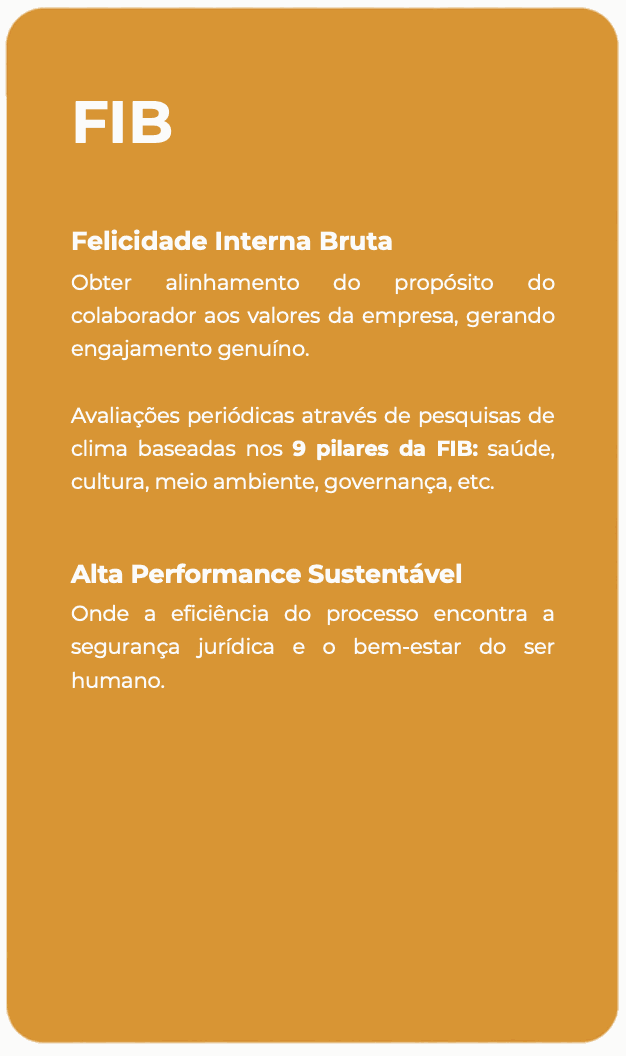
GNH · Gross National Happiness
Understand Gross National Happiness and reflect on how health, purpose, relationships, human development and quality of life impact wellbeing and the sustainability of results.
Healthy professional relationships
Strengthen the prevention of harassment, discrimination and violence at work, promoting psychological safety, healthy relationships and a culture aligned with Law No. 14,457/2022 and NR-5.
Evolution through the 3 Fs: frustration, failure and fortitude
Reflecting on frustrations, mistakes and adversity at work, developing emotional and behavioural resources that promote learning, adaptation and sustainable performance.
The “S” in ESG: people and human sustainability
Understand the strategic role of the Social pillar of ESG in building more humane, sustainable organisations prepared for current challenges.
Complementary solutions in Organisational Health, NR-1 and Social ESG
Supporting organisations in the prevention of psychosocial risks, promotion of mental health and compliance with legal and regulatory requirements.
NR-1 · Management of psychosocial risks
Supporting organisations in identifying, assessing and managing work-related psychosocial risk factors, contributing to the creation of healthy environments aligned with the requirements of NR-1. Activities may include diagnoses, assessments, training, action plans and leadership development.
Law 14.457/22 and NR-5 · Prevention of harassment
To assist companies in implementing measures aimed at the prevention of bullying, sexual harassment and other forms of violence at work, strengthening the role of the CIPAA, team awareness and the building of an organisational culture based on respect, ethics and psychological safety.
Mental Health Promoting Company Certification
To offer support to organisations wishing to strengthen their practices in promoting mental health and wellbeing, contributing to the development of programmes, leadership training and the implementation of initiatives aligned with the requirements of Law 14.831/2024.
5-step progressive journey: from diagnosis to ESG impact report
Diagnosis
Evaluation free of psychosocial risks, organisational culture and the company's specific needs.
- Diagnostic questionnaire
- Organisational climate survey
- NR-1 risk identification
- Initial diagnostic report
No cost · No obligation
Customised proposal
Programme as with workshops, training courses and a schedule tailored to the organisation's reality and objectives.
- Selection of thematic blocks
- Customised schedule
- In-person or online mode
- Alignment with ESG goals
Customised 100% programme
Implementation
Face-to-face or online workshops, leadership training, NR-1 action plans and the strengthening of the CIPA.
- Mental health workshops
- Leadership training
- Documented action plans
- Continuous monitoring
In-person · Online · Hybrid
NR-1 and NR-5 action plans
Evidence and recommendations to support the management of psychosocial risks, CIPAA and the continuous improvement of wellbeing at work.
- NR-1 action plan
- Inputs for CIPAA, NR-5
- Psychosocial health indicators
- Inputs for ESG Reports, Pillar S
ESG Social Framework
Analytics
- General Mental Health Index
- Burnout Index
- Psychological Safety Index
- Leadership Index
- Engagement Index
- Climate Index
- Overload Index
- Department rankings
- Heatmap
- Quarterly trend
- Benchmark between units
Happiness, Mental Health & Skills Development Programme
Connecting corporate happiness, organisational health, competency development and the prevention of psychosocial risks for sustainable results.
Customised proposal for the company
Tailor-made workshop schedule
Results and impact report